Operational note: Gear counters surveillance in the field. Books counter it in the mind. The two work together. Every product we sell was built on the intellectual framework in this list — read these, and you’ll understand why the tools exist, not just how to use them.
If you’re going to operate effectively against mass surveillance — whether you’re a journalist, an activist, a privacy researcher, or just someone who refuses to live inside a data cage — you need the theory behind the practice. These 10 books are not suggestions. They are operational requirements.
1. The Art of Invisibility
Kevin Mitnick
Mitnick spent years as the FBI’s most-wanted hacker. He also spent years hiding from the FBI. That experience translates into a practical, unglamorous, real-world guide to digital and physical invisibility that no academic can replicate.
This book works chapter by chapter through the attack surfaces in your daily life: your phone, your email, your bank, your physical movements. Each chapter ends with specific, actionable countermeasures. Not theory. Steps.
Why it’s on this list
Mitnick’s credibility comes from experience, not credentials. He tested these techniques under operational pressure. That makes this the most immediately actionable book in the genre.
Pairs with: Our Guides Library for the physical-layer complement to Mitnick’s digital toolkit.
2. Extreme Privacy
Michael Bazzell
Bazzell is a former federal law enforcement officer who spent years building the surveillance apparatus — and has now dedicated his career to helping people dismantle their exposure to it. Extreme Privacy is the most technically comprehensive privacy manual in print.
This is the book for people who are serious. Burner phone configurations. Data broker opt-outs. Mail forwarding structures. Virtual addresses. LLC formations for privacy. Bazzell goes deep and expects you to follow.
Why it’s on this list
No other book gives you a complete, current, step-by-step system for disappearing from commercial data infrastructure. Updated annually. The 2024 edition contains specific workflows no other source covers.
Pairs with: Faraday pouches and RF detection gear — Bazzell’s phone protocols require physical signal blocking to complete the system.
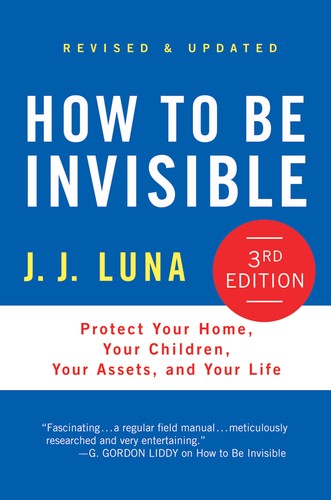
3. How to Be Invisible
J.J. Luna
Luna began writing this book after being stalked and nearly killed. It reads like it. Where Bazzell is clinical, Luna is motivated by genuine fear — and that fear produces a different quality of advice: the kind that protects your life, not just your data.
The focus here is physical location privacy: how to ensure that no one can find your home address, your vehicle registration, your daily route, or your family members. Luna covers New Mexico LLCs, ghost addresses, and nominee structures long before these became mainstream privacy concepts.
Why it’s on this list
Most privacy guides underweight the physical layer. Luna weights it correctly. The threat model is: someone wants to find where you sleep. How do you prevent that?
4. The Age of Surveillance Capitalism
Shoshana Zuboff
This is the theoretical framework. Zuboff, a Harvard Business School professor, spent years analyzing how Google, Facebook, and their peers invented a new economic logic: the extraction of behavioral data as raw material for predicting and modifying human behavior at scale.
Surveillance Capitalism is not a light read. It is a 700-page argument that what you experience as “convenience” is actually the most comprehensive behavioral modification experiment in human history. Zuboff names it. She explains the mechanism. She shows you how you became the product.
Why it’s on this list
You cannot build a coherent counter-surveillance strategy without understanding what you’re countering. This book gives you the enemy’s doctrine. Every piece of adversarial gear we sell makes more sense after you’ve read it.
5. No Place to Hide
Glenn Greenwald
Greenwald was the journalist Edward Snowden trusted with the NSA documents. This book is his account of that relationship and the surveillance architecture those documents revealed: PRISM, XKeyscore, MUSCULAR, and the range of collection systems the NSA built with the active cooperation of major technology companies.
What distinguishes this book from other Snowden accounts is Greenwald’s legal analysis. He examines the legal and constitutional frameworks that permitted the NSA to build a global surveillance infrastructure without meaningful oversight, and what that framework means for everyone who uses the internet.
Why it’s on this list
The threat model for serious privacy operatives includes state-level actors, not just commercial data brokers. Greenwald explains the government layer with primary source documentation.
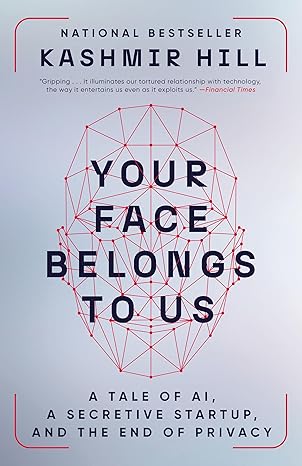
6. Your Face Belongs to Us
Kashmir Hill
Hill is a New York Times technology reporter who investigated Clearview AI for years before the story broke. This book is the definitive account of how a company built a facial recognition database of 10+ billion images scraped from the public internet and sold access to law enforcement, private investigators, and anyone who would pay.
The implications are not abstract. Clearview’s database can identify anyone who has ever appeared in a publicly indexed photograph. Hill interviews the people who were wrongly identified, the police departments who misused the tool, and the investors who funded it.
Why it’s on this list
Facial recognition is the most urgent physical-layer threat to protest participants. Understanding how Clearview was built and how it operates gives you the specific threat model that adversarial pattern clothing and IR-defeating gear are designed to address.
7. Obfuscation
Finn Brunton & Helen Nissenbaum
Brunton and Nissenbaum introduce a concept that should be in every privacy practitioner’s vocabulary: obfuscation — the deliberate generation of noise, false signals, and misleading data to confuse surveillance systems.
This is the intellectual foundation behind everything from cookie stuffers to adversarial patterns to IR LED overexposure. The insight is elegant: when you cannot prevent data collection, you can corrupt the quality of the data collected. A surveillance system that sees everything but cannot distinguish signal from noise is functionally blind.
Why it’s on this list
This is the theoretical grounding for adversarial AI counter-measures. The Cap_able adversarial hoodie and the DIY IR Hoodie Kit are practical implementations of obfuscation theory. Read this to understand why they work at the systems level.
8. Privacy is Power
Carissa Véliz
Véliz, an Oxford philosopher, makes the most direct moral argument in this list: privacy is not a preference or a convenience. It is a prerequisite for political freedom, autonomous thought, and functioning democracy. The erosion of privacy is not a side effect of the digital economy — it is the mechanism by which power is extracted from individuals and concentrated in institutions.
The book is short, precise, and readable. Véliz does not waste words. She also provides a policy agenda and individual action framework that complements the technical approaches in other books on this list.
Why it’s on this list
For anyone who needs to articulate why this work matters — to themselves, to collaborators, to the people they’re trying to protect — Véliz gives you the argument. This is the ethical framework that the gear operates within.
9. Invisibility Toolkit
Various Authors
A practical compendium — 100 methods for reducing your physical and digital footprint across everyday contexts. Where Bazzell goes deep on systems, the Invisibility Toolkit goes wide across situations: moving to a new city without a trail, paying for things without a paper record, using public spaces without being tracked, and dozens of other scenarios.
This is the reference manual. When you need a specific technique for a specific situation, this is where you look.
Why it’s on this list
Counter-surveillance is mostly situational. You need a framework (Zuboff, Véliz), a deep methodology (Bazzell, Luna), and a reference for edge cases. This is the reference.
10. Nothing to Hide
Daniel J. Solove
“If you’ve done nothing wrong, you have nothing to hide.” Solove, a law professor and leading privacy scholar, spends an entire book systematically dismantling this argument — the single most effective weapon in the pro-surveillance arsenal.
The argument is wrong on its logic. It conflates privacy with secrecy. It assumes a perfect government with perfect judgment. It ignores the chilling effect of surveillance on lawful behavior. Solove unpacks every flaw with precision and provides the counter-arguments you need to win the debate wherever you encounter it.
Why it’s on this list
You will encounter “nothing to hide” constantly. From family members, from policymakers, from people you’re trying to organize. Solove hands you the refutation. Read the relevant chapters and you will never be caught flat-footed by that argument again.
The Full Library
All 10 books are available in our Guides section with detailed reviews, format options, and related reading recommendations.
The reading order we recommend:
- Start with the why: Zuboff → Véliz → Solove
- Build the threat model: Greenwald → Hill → Brunton & Nissenbaum
- Implement the countermeasures: Mitnick → Bazzell → Luna → Invisibility Toolkit
Then gear up. The reading tells you what you’re up against. The equipment tells you what to do about it.
Related reading: Portland Field Guide · Singapore Surveillance · Browse Guides Library · Shop All Gear