Updated February 2026. Documented abuses, legal challenges, and countermeasures. Sources at bottom.
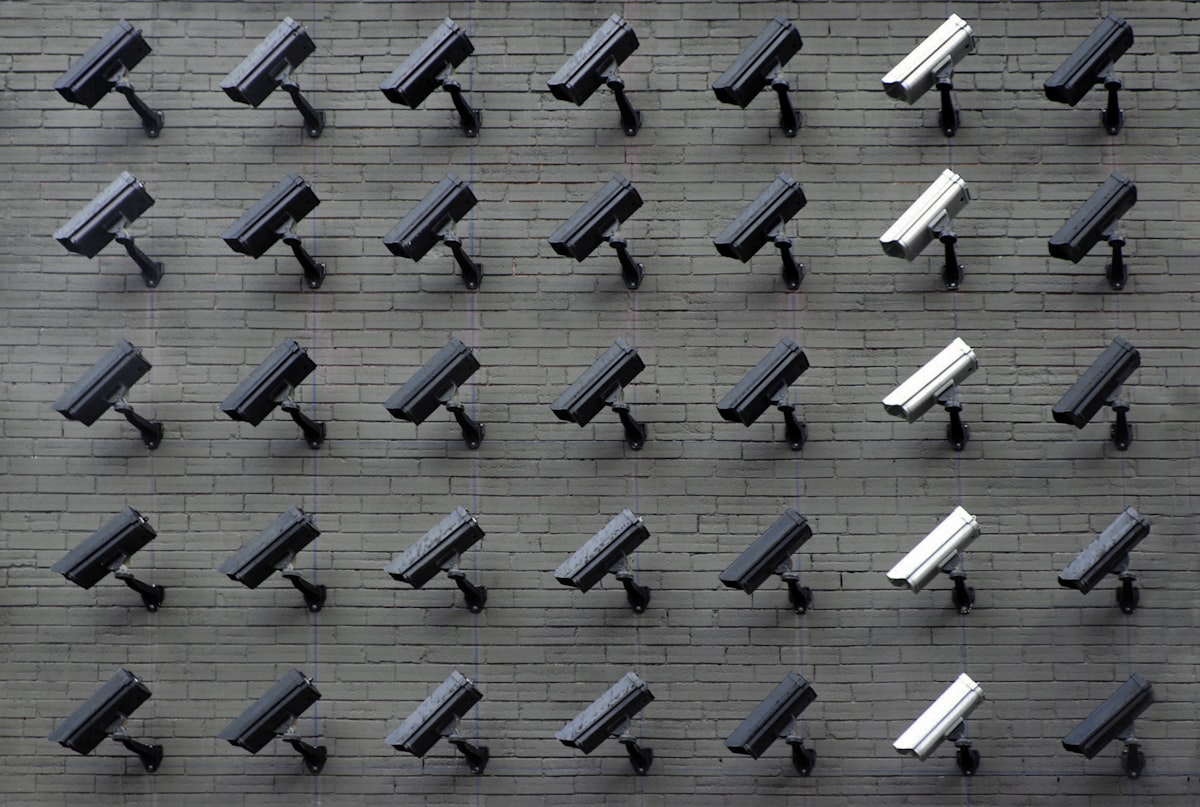
The cameras are easy to miss. Small, solar-powered, mounted on poles at intersections, parking lots, neighborhood entrances, and highway on-ramps, they look like any other piece of unremarkable infrastructure. But every time your car passes one, it photographs your license plate, logs your make, model, and color, notes any distinguishing details — a bumper sticker, a roof rack — and timestamps your position with GPS precision. That record uploads to a national cloud database, where it sits alongside billions of identical records from thousands of other cameras across 49 states. Any law enforcement officer, anywhere in the country, can query that database without a warrant. You didn’t consent to any of this. You were never asked.
This is Flock Safety. Founded in 2017 as a neighborhood crime-watch novelty, it has metastasized into the most comprehensive private surveillance network ever deployed on American public roads. By 2026, it processes billions of plate reads per month. It has partnerships with thousands of police departments, schools, homeowners associations, and private businesses. It has expanded into AI video analysis, gunshot detection, audio sensors that listen for screams, and integrations with commercial data brokers for “person lookups.” And it has been repeatedly caught enabling exactly the abuses its critics predicted: tracking women seeking abortions, feeding immigration enforcement in sanctuary cities, and enabling discriminatory searches targeting minority communities.
The thesis is simple: Flock Safety is not a crime-fighting tool that happens to raise privacy concerns. It is a mass-surveillance infrastructure that was built, scaled, and sold to law enforcement before anyone had a serious conversation about what it would be used for — and the documented record of misuse proves the concern was warranted from the start.
The Machine: What Flock Actually Collects
Most people imagine automated license plate readers as cameras that photograph a plate and match it against a hotlist of stolen vehicles. That description is technically accurate and strategically incomplete. Flock’s cameras capture far more than a plate number, and the platform’s power comes not from any single data point but from what happens when you aggregate millions of them.
Each Flock unit records your plate in high resolution, your vehicle’s make, model, and color, any visible modifications or features (bumper stickers, roof racks, damage), a GPS-accurate location, and a precise timestamp. In many configurations, it also captures a 15-second video clip that can include visible passengers. All of this is uploaded to Flock’s cloud platform, which offers natural-language search: an officer can query “white pickup truck with ladder rack, southbound on Route 9 between Tuesday and Thursday” and retrieve a result set. Retention defaults to 30 days but is extendable by agencies.
Flock Safety platform capabilities as of 2026:
| Capability | Detail |
|---|---|
| Network coverage | 49 states / 5,000+ communities |
| Monthly plate scans | Billions (company-reported) |
| Data sharing | Opt-in network (radius / state / national) |
| Default retention | 30 days (extendable) |
| Additional sensors | Audio distress detection, gunshot detection |
| Integrations | Data brokers, drone partnerships, Ring (canceled) |
| Warrant requirement | None |
Beyond ALPRs, Flock’s product line now includes video cameras with AI analysis capabilities, microphones configured to detect “human distress” sounds (screams, cries), and a feature called “person lookups” built on commercial data broker integrations. The company’s marketing frames all of this as a unified “public safety platform.” What it describes, structurally, is total-visibility infrastructure for roads, streets, and public spaces.
The Scale Problem: One Camera vs. a Grid
Here is the argument Flock and its defenders make: a single license plate reader in a public space is legally no different from a police officer standing on a corner and writing down plates by hand. Courts have consistently agreed that there is no expectation of privacy for a vehicle’s license plate in public. That argument is both technically correct and fundamentally dishonest.
The difference between a single observation and a surveillance grid is not degree — it is kind. When every intersection, parking lot, and neighborhood entrance in a city has a Flock camera, and all of those cameras report to a searchable shared database, the aggregate record reveals something categorically different from what any individual camera captures: the entire pattern of a person’s life. Where they worship. Which doctors they see. Which political events they attend. Who they spend time with. Whether they crossed state lines for medical care.
One Norfolk, Virginia driver was logged 526 times in four months — not by one camera following them, but by the invisible accumulation of routine drives past the city’s Flock network. That record, fully assembled, constitutes a more complete profile of daily life than most people’s own calendars.
This is the argument the Supreme Court made in Carpenter v. United States (2018), which required warrants for cell-site location data on the grounds that sustained location tracking “achieves near perfect surveillance, as if it had attached an ankle monitor to the phone’s user.” Flock’s network does the same thing for cars — and, by extension, for their owners.
The Pitch: Why Agencies Buy In
It would be dishonest to pretend that Flock has no genuine use cases. Police departments point to real outcomes: stolen vehicles recovered within hours of a crime report, hit-and-run suspects identified from partial plate captures, Amber Alert resolutions, patterns in commercial burglary rings identified by repeated plate sightings. For under-resourced departments, the appeal of automated, always-on surveillance is real.
Flock’s sales pitch leans hard on “objectivity”: a camera doesn’t racially profile; it reads every plate the same way. Data ownership stays with the purchasing agency. Their “SafeList” feature lets residents register their own vehicles to suppress neighborhood alerts. Ethics pledges. Regular audits. A 30-day default retention window. On paper, the guardrails look reasonable.
The problem is that guardrails on a surveillance system only hold as long as everyone using the system respects them — and the documented record shows they don’t. The existence of policy does not constrain determined misuse. What constrains misuse is oversight, and Flock’s model has structurally minimized the oversight that would catch it.
The Fourth Amendment Collision
The legal landscape around ALPR networks is actively contested, with courts beginning to grapple with the gap between existing precedent — which permits individual plate reads in public — and the surveillance reality that networks of hundreds of cameras create.
Schmidt v. City of Norfolk (2026)
In January 2026, a federal judge dismissed a Fourth Amendment challenge to Norfolk’s 176-camera Flock network. The ruling held that point-in-time plate captures and 30-day retention do not yet rise to the level of sustained location tracking that would require a warrant under Carpenter. But the opinion was notably qualified: the judge explicitly warned that denser networks and AI pattern analysis could cross that threshold. The case is now before the Fourth Circuit, with amicus support from EFF and ACLU. → The Record
EFF & ACLU v. San Jose (2025)
A California lawsuit documented 3,965,519 ALPR queries executed by San Jose police in a single year — the overwhelming majority without any predicate suspicion, constituting what plaintiffs described as routine warrantless fishing through the location histories of millions of drivers. The suit invokes California’s stricter state privacy framework in addition to Fourth Amendment grounds. → EFF press release
State Responses
Several states have moved ahead of federal courts. Colorado now mandates warrants for ALPR data access. Washington State’s investigation exposed what its report called “side-door” access, with Border Patrol mining Flock data through local law enforcement proxies in jurisdictions where direct federal access was prohibited. Illinois audited Flock directly for CBP access violations, forcing a nationwide pause on federal pilot programs. → UW Human Rights report
Documented Abuses: Abortion, Immigration, Bias
Flock consistently responds to abuse allegations with a version of the same statement: individual officers who misuse the platform violate terms of service and are subject to disciplinary action. This framing treats documented systemic patterns as isolated personnel problems, which is precisely backwards. The following abuses were not discovered by Flock’s internal audits. They were uncovered by civil liberties organizations, journalists, and state investigators.
Texas — Abortion Investigation
Texas sheriff’s deputies queried Flock’s national network during what was logged internally as an abortion “death investigation,” with search parameters including a query for female subjects who “had an abortion.” The queries were executed across state lines, using Flock’s nationwide sharing network, without any warrant. Documented by EFF in their 2025 abuse review. → EFF
Nationwide — Discriminatory Queries
EFF’s investigation of Flock query logs found hundreds of searches using ethnic slurs targeting Romani people. These were not anomalous queries from a single bad actor; the pattern appeared across multiple agencies and jurisdictions, indicating no systemic flag for discriminatory search terms in Flock’s platform. → EFF
Illinois / Washington State — Immigration Enforcement
ICE and CBP accessed Flock data through local law enforcement in sanctuary cities, using agencies as proxy access points that technically complied with local non-cooperation policies while functionally routing federal immigration enforcement through the network. Washington State’s investigation identified 18 agencies sharing data with federal immigration authorities without authorization. When the Illinois audit exposed direct CBP access violations, Flock paused federal pilot programs nationwide — confirming the access had been happening. → UW report / → GovTech
Multiple Jurisdictions — Officer Stalking
Multiple documented cases exist of law enforcement personnel using Flock access to track ex-partners and individuals with whom they had personal conflicts. These cases resulted in officer terminations and, in some instances, criminal charges — but were not caught by Flock’s audit mechanisms. They surfaced through unrelated internal investigations.
Security Failures and Open Feeds
Flock maintains that its platform has never experienced a major breach. That claim is technically narrow and practically misleading. The relevant security question is not whether Flock’s central database has been exfiltrated — it is whether the broader system has been exposed. The answer is yes, repeatedly.
In early 2026, security researchers documented what became known as the Condor exposures: misconfigured Flock-connected cameras that allowed unauthenticated outside access to live feeds, historical archives, and camera controls. In some cases, access required no credentials at all. Researchers testing their own cameras obtained access within seconds. The exposed systems included cameras positioned to capture footage of playgrounds and schools. → 404 Media
Separately, a redaction processing error exposed the identities of millions of subjects in public records requests that agencies fulfilled using Flock data — records that were supposed to have identifying information stripped before release. → 404 Media Congressional investigators, including Rep. Krishnamoorthi and Sen. Wyden, urged FTC investigation. → Congressional press release
The security failure that matters most with a surveillance network is not a headline breach. It is the slow accumulation of misconfigurations, unauthorized access, and data leakage that the company’s own systems never flag — because they weren’t designed to look for it.
The Backlash: Cities Walking Away
The period from late 2025 through early 2026 has seen an accelerating wave of Flock contract terminations, driven by documented abuses, the shifting political climate around immigration enforcement, and the February 2026 cancellation of Amazon Ring’s Flock partnership following public backlash over ICE surveillance.
Cities and agencies that have terminated or are challenging Flock contracts include: Santa Cruz CA (Jan 2026), Austin TX, Cambridge MA, Flagstaff AZ, Evanston IL, Eugene OR, Mountain View CA, Hillsborough NC — plus Denver CO (ACLU demanding termination) and 30+ additional communities since 2025. → NPR
State-level legislation has followed. Colorado now mandates warrants for ALPR access. Multiple states are advancing similar measures. → Stateline A November 2025 ruling in Rhode Island established Flock data as public records subject to disclosure laws. → East Bay RI
Amazon canceled its Ring partnership with Flock in February 2026, citing privacy concerns after public pressure — a significant blow to Flock’s consumer expansion strategy. → KTVZ
How to Fight Back
Awareness is the first step. Most people have no idea how many times they’ve been scanned, or what that data has been used for. Flock does not notify individuals that their plate has been captured or queried. There is no opt-out. The only meaningful responses are political — demanding that your city terminate its Flock contract, supporting legislation that requires warrants for ALPR data access, and backing the civil liberties organizations actively litigating these cases.
At the individual level, countermeasures exist. License plate covers and coatings that interfere with IR-based plate readers are subject to varying state laws — check your jurisdiction before using them. Some states prohibit any plate obstruction; others only regulate covers that render plates unreadable to humans. The legal landscape is genuinely complex and worth researching carefully before acting.
The broader toolkit of anti-surveillance gear — IR-blocking eyewear, adversarial pattern clothing that disrupts computer vision systems, Faraday pouches that eliminate phone tracking — addresses the wider surveillance ecosystem of which Flock is only one component. Facial recognition, drone surveillance, AI-powered CCTV, and data broker ecosystems all interact with the data Flock generates to create a far more complete picture than any single system produces alone.
The legal and political battles around Flock will define whether warrantless mass surveillance of vehicle movements becomes a permanent feature of American public space, or whether courts and legislatures draw the line that Carpenter suggested but didn’t complete. Those battles are happening now, and their outcomes depend in part on how many people understand what is actually at stake — which is why the first act of resistance is simply knowing what these cameras are, and what they do with what they see.
Sources: NPR · EFF 2025 Review · The Record · EFF v. San Jose · Stateline · 404 Media (cameras) · 404 Media (redaction) · ACLU · Ring cancellation · GovTech · UW Human Rights · Santa Cruz Local · ACLU Colorado · Institute for Justice · East Bay RI · Congress
Related: Singapore Surveillance State · Seattle Protests Field Guide · Shop Counter-Surveillance Gear