
Why the order matters: Most propaganda reading lists dump Chomsky and Ellul on you first and wonder why you stopped reading. We built this list as a staircase: each book lays the foundation for the next. Start with how persuasion works in your brain, move through how media systems exploit those mechanics, and arrive at the structural and philosophical analysis only when you’re ready to absorb it. Skip the order at your own risk.
You don’t defeat propaganda by consuming more media. You defeat it by understanding how media consumes you. These 10 books, ranked from most accessible to most academic, form a complete intellectual toolkit for recognizing manipulation at every level: psychological, institutional, and environmental.
Every book links to its full review and details in our Guides library, where you’ll find related reading, author backgrounds, and format options.
1. Influence: The Psychology of Persuasion
Robert B. Cialdini
★☆☆☆☆ Accessible to anyone
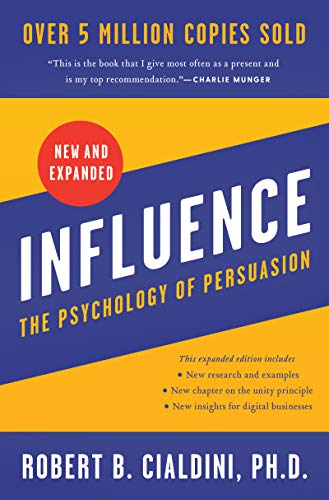
Before you can understand propaganda, you need to understand why humans are persuadable in the first place. Cialdini spent 35 years studying the answer and distilled it into six principles: reciprocity, commitment, social proof, authority, liking, and scarcity. The revised edition adds a seventh, unity, covering the tribal identity triggers that social media has weaponized.
In one experiment, a researcher approached people using a Xerox machine and asked to cut in line. When she said, “Excuse me, I have five pages. May I use the Xerox machine?” only 60% complied. But when she added the word because and gave a meaningless reason (“May I use the Xerox machine, because I have to make copies?”), compliance jumped to 93%. The trigger word because activated an automatic response, regardless of the logic that followed it. Cialdini calls this “click, whirr” behavior: the right cue fires a fixed action pattern, bypassing critical thought entirely.
This is pop psychology done right. No jargon. No academic bloat. Just a clear, research-backed explanation of the cognitive vulnerabilities that every propagandist, marketer, and cult leader exploits, whether they’ve read Cialdini or not.
Why you read this first
Every other book on this list describes systems that exploit these six principles. Without Cialdini, you’re watching the game without knowing the rules.
2. Trust Me, I’m Lying
Ryan Holiday
★★☆☆☆ Light reading, some background helpful
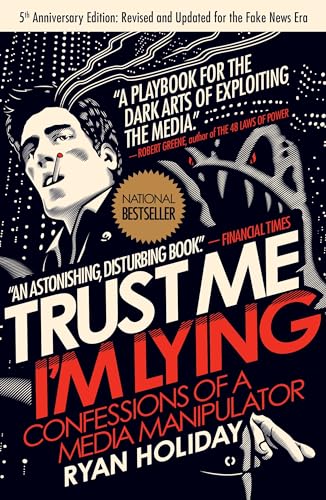
Ryan Holiday was a professional media manipulator. He planted fake stories on blogs, traded them up the media chain until they hit the New York Times, and manufactured outrage cycles on demand. Then he wrote this book confessing exactly how he did it.
“I would fabricate stories, put them on blogs, and then watch as they were reported by the mainstream media as though they were real. The economics of the internet created a twisted set of incentives that made this not only possible but easy. Blogs need traffic. Traffic comes from controversy. And controversy can be manufactured.”
What makes Trust Me, I’m Lying essential is its practitioner’s perspective. This isn’t a professor explaining how media should work. It’s a guy who broke the system explaining how it actually works. Holiday shows you the specific mechanics: how headlines are engineered to trigger shares, how corrections generate more traffic than the original lie, and how the economics of online publishing guarantee that accuracy loses to speed every time.
Read this right after Cialdini and you’ll see Cialdini’s principles weaponized in real time. Holiday’s outrage manufacturing is social proof and authority manipulation applied to the news cycle.
The uncomfortable part
Holiday confesses this without real remorse. He’s not warning you. He’s showing you the game and daring you to keep playing.
3. Propaganda (1928)
Edward Bernays
★★☆☆☆ Light reading, some background helpful
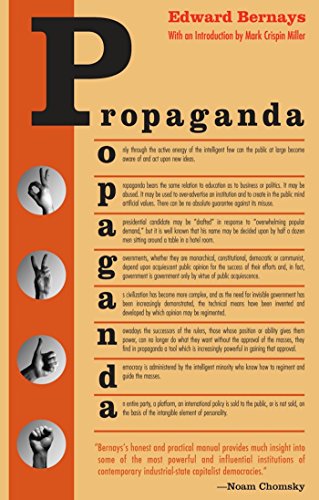
This is where it all started. Written in 1928 by Sigmund Freud’s nephew, Propaganda is the founding document of modern public relations, and it reads like a villain’s origin story.
Bernays doesn’t call propaganda a necessary evil. He calls it a necessary good. He argues, without apparent irony, that the manipulation of public opinion is an essential feature of democracy, not a flaw. The people who pull the strings are not conspirators. They are, in Bernays’ telling, civic servants.
“The conscious and intelligent manipulation of the organized habits and opinions of the masses is an important element in democratic society. Those who manipulate this unseen mechanism of society constitute an invisible government which is the true ruling power of our country.
We are governed, our minds are molded, our tastes formed, our ideas suggested, largely by men we have never heard of. This is a logical result of the way in which our democratic society is organized. Vast numbers of human beings must cooperate in this manner if they are to live together as a smoothly functioning society.
In almost every act of our daily lives, whether in the sphere of politics or business, in our social conduct or our ethical thinking, we are dominated by the relatively small number of persons who understand the mental processes and social patterns of the masses. It is they who pull the wires which control the public mind, who harness old social forces and contrive new ways to bind and guide the world.”
"It is they who pull the wires which control the public mind, who harness old social forces and contrive new ways to bind and guide the world."
— Edward Bernays, Propaganda (1928)That passage is the opening of the book. Written in 1928. Published openly, without shame, as a guide for how democracy actually functions.
This is a short book. Under 170 pages. You can finish it in an afternoon. But the ideas inside it built the advertising industry, shaped wartime propaganda, and established the playbook that every government and corporation has followed since. Noam Chomsky called it “an honest and practical manual,” because Bernays was frank enough to say the quiet part out loud.
The historical impact
Bernays convinced a generation of women to start smoking by branding cigarettes “Torches of Freedom” at a 1929 Easter parade. He engineered the 1954 Guatemalan coup through planted media stories. The man practiced what he preached.
Why it matters now
Every critique that follows on this list, from Chomsky to Postman to Ellul, is ultimately a response to the system Bernays built. Read the source first.
"Propaganda," Chapter III: The New Propagandists
Who are the men who, without our realizing it, give us our ideas, tell us whom to admire and whom to despise, what to believe about the ownership of public utilities, about the tariff, about the price of rubber, about immigration; who tell us how our houses should be designed, what furniture we should put in them, what menus we should serve on our table, what kind of shirts we should wear, what sports we should indulge in, what plays we should see, what charities we should support, what pictures we should admire, what slang we should affect, what jokes we should laugh at?
If we set out to make a list of the men and women who, because of their position in public life, might fairly be called the molders of public opinion, we could quickly arrive at an extended list. It would obviously include the President of the United States and the members of his Cabinet; the Senators and Representatives in Congress; the Governors of our forty-eight states; the presidents of the chambers of commerce in our hundred largest cities; the chairmen of the boards of directors of our hundred or so largest industrial corporations; the presidents of the labor unions affiliated in the American Federation of Labor; the president of each of the national professional and fraternal organizations; the president of each of the racial or language societies in the country; the hundred leading newspaper and magazine editors; the fifty most popular authors; the presidents of our colleges and universities.
Such a list would comprise several thousand persons. But it is well known that many of these leaders are themselves led, sometimes by persons whose names are known to few. Many a congressman, in framing his platform, is guided by a national party organization without ever having met its members. Invisible wires lead to invisible hands. The invisible government tends to be concentrated in the hands of the few because of the expense of manipulating the social machinery which controls the opinions and habits of the masses.
To advertise on a scale which will reach fifty million persons is expensive. To reach and persuade the group leaders who dictate the public's thoughts and actions is likewise expensive. For this reason there is an increasing tendency to concentrate the functions of propaganda in the hands of the propaganda specialist. This specialist is more and more assuming a distinct place and function in our national life.
4. Media Control
Noam Chomsky
★★★☆☆ Moderate, attentive reader

If you’ve never read Chomsky, start here, not with Manufacturing Consent. This thin pamphlet (around 100 pages) delivers his core thesis without the academic density that stops most readers cold.
Chomsky traces the arc of American propaganda from Woodrow Wilson’s Creel Committee, which turned a pacifist nation into war enthusiasts in months, through to the manufactured consent for the Gulf War. His central claim: propaganda serves democracy the way the bludgeon serves totalitarianism. Democratic societies can’t beat people into compliance, so they manufacture the illusion of choice instead.
“The point of public relations slogans like ‘Support Our Troops’ is that they don’t mean anything. They mean as much as whether you support the people in Iowa. Of course. What’s the point? The point of sloganeering is to get people to stop thinking.”
The “bewildered herd” concept lands hard after reading Cialdini and Bernays. You already know how people are persuaded (Cialdini) and who designed the system (Bernays). Chomsky shows you why the system exists: because the alternative is a population that might actually govern itself.
How to read this
Read this in one sitting. It’s short enough, and the argument builds momentum that rewards uninterrupted reading.
5. Amusing Ourselves to Death (1985)
Neil Postman
★★★☆☆ Moderate, attentive reader
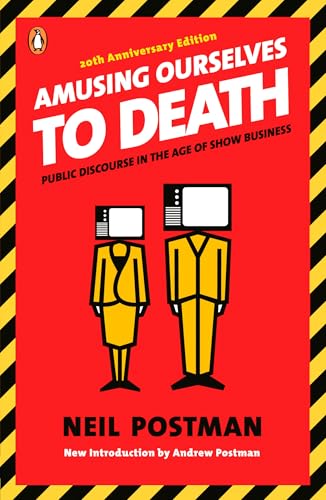
Published in 1985, before the World Wide Web, before social media, before smartphones, this book predicted all of it with terrifying accuracy.
Postman’s argument is elegantly simple: George Orwell was wrong. Aldous Huxley was right. We weren’t enslaved by what we fear (surveillance, censorship, book burning). We were enslaved by what we love (entertainment, distraction, infinite content). The government didn’t need to ban books. It just needed to make sure nobody wanted to read them.
“What Orwell feared were those who would ban books. What Huxley feared was that there would be no reason to ban a book, for there would be no one who wanted to read one. Orwell feared those who would deprive us of information. Huxley feared those who would give us so much that we would be reduced to passivity and egoism.”
Where Chomsky focuses on institutional manipulation, Postman focuses on the medium itself. Television didn’t just deliver propaganda. It became propaganda by training audiences to expect entertainment from everything, including news, politics, education, and religion. Every serious subject became a performance. Every performance became a product.
The line that haunts
“When a population becomes distracted by trivia, when cultural life is redefined as a perpetual round of entertainments… then a nation finds itself at risk.”
He wrote that in 1985. Scroll through your feed tonight and tell me he was wrong.
6. The Shallows
Nicholas Carr
★★★☆☆ Moderate, attentive reader

Postman told you the medium was the problem. Carr tells you what the medium is doing to your brain, literally, at the neurological level.
This Pulitzer Prize finalist marshals neuroscience research to demonstrate that internet use (hyperlinks, notifications, infinite scroll, tab-switching) physically rewires neural pathways. The brain adapts to expect constant stimulation and loses its capacity for the sustained, linear attention required for critical reading. You’re not choosing to skim. Your brain is being trained to skim.
“The Net’s interactivity gives us powerful new tools for finding information, expressing ourselves, and conversing with others. It also turns us into lab rats constantly pressing levers to get tiny pellets of social or intellectual nourishment.”
The propaganda implications are devastating: a population that can’t sustain attention long enough to follow a complex argument is a population that can only process slogans, headlines, and emotional triggers. Carr doesn’t frame it as a propaganda book, but after reading the first five books on this list, the connection is unmistakable. The internet doesn’t just deliver propaganda more efficiently. It makes human brains more receptive to it.
The irony
You’re probably reading this on the device that’s doing the rewiring.
7. Necessary Illusions (1989)
Noam Chomsky
★★★★☆ Dense, rewards slow reading
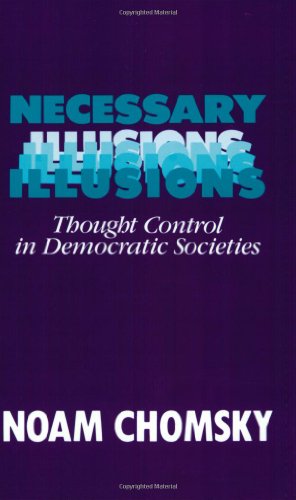
The difficulty jump is real. This is Chomsky’s CBC Massey Lectures from 1988, expanded into a full analytical framework for understanding thought control in democratic societies.
The first 130 pages are lecture-derived and readable, roughly the same level as Media Control but with more historical depth. Then comes the 220-page appendix, which is pure primary-source documentation verifying every claim with newspaper excerpts, government records, and declassified materials. It’s not meant to be read linearly. It’s meant to be checked against.
“The beauty of the democratic systems of thought control is that they operate within a framework of formal freedom. Censorship is unnecessary when self-censorship dominates. And self-censorship dominates when the spectrum of thinkable thought is bounded by the presuppositions of the discourse itself.”
Chomsky’s central thesis here is sharper than in Media Control: democratic societies require more sophisticated thought control than totalitarian ones, because the population can’t simply be threatened into compliance. The “necessary illusions,” the consensus assumptions that are never questioned, are maintained not by censorship but by the structure of acceptable debate. The boundaries of discussion are set before the discussion begins.
How to read this
Read the lectures. Then pick the topic that angers you most and verify it in the appendix. That’s when the book lands.
8. Understanding Power (2002)
Noam Chomsky
★★★★☆ Dense, rewards slow reading

If Manufacturing Consent feels too monolithic, this is the alternative path to the same intellectual territory.
Compiled from discussion transcripts and Q&A sessions, Understanding Power gives you Chomsky in conversational mode: responding to questions from real audiences, clarifying points in real time, and covering a staggering range of topics. US foreign policy, media structure, education, social change theory, and domestic politics. The editors designed it to be read non-linearly. Open to any chapter and get a self-contained argument.
“The smart way to keep people passive and obedient is to strictly limit the spectrum of acceptable opinion, but allow very lively debate within that spectrum. Then people get the sense that there’s free thinking going on, while all the time the presuppositions of the system are being reinforced by the limits put on the range of the debate.”
The footnotes are the hidden treasure. Every factual claim is cited and independently verifiable. The editors spent years cross-referencing Chomsky’s statements against primary sources. It’s as close to a searchable Chomsky database as exists in print.
Why it’s here and not earlier
The 416-page length and breadth of subjects demand a reader who already has the framework from books 1 through 6. Without that context, it’s overwhelming. With it, it’s revelatory.
9. Manufacturing Consent (1988)
Edward S. Herman & Noam Chomsky
★★★★☆ Dense, rewards slow reading

This is the book. The most cited work in social sciences on media structure. The one that changed how an entire generation understood the news they consumed.
Herman and Chomsky’s Propaganda Model identifies five structural filters that systematically bias US media output toward elite interests, without requiring any conspiracy or editorial coordination:
- Ownership: Media companies are large corporations with their own profit motives
- Advertising: The real customers are advertisers, not readers
- Sourcing: Reporters depend on official sources who set the narrative frame
- Flak: Organized campaigns punish coverage that challenges power
- Fear ideology: Anti-communism (now anti-terrorism) as a disciplinary mechanism
“If the powerful are able to fix the premises of discourse, to decide what the general populace is allowed to see, hear, and think about, and to ‘manage’ public opinion by regular propaganda campaigns, the standard view of how the system works is at serious odds with reality.”
The genius of the model is its structural elegance: no one needs to pick up a phone and order a cover-up. The system produces predictable output through economic incentives alone. Journalists aren’t corrupt. They’re operating rationally within a system that rewards certain stories and buries others.
The case studies are devastating. Herman and Chomsky compare the coverage of “worthy victims” (killed by US enemies) versus “unworthy victims” (killed by US allies) and demonstrate, with meticulous documentation, that the coverage patterns are exactly what the propaganda model predicts.
This is not optional reading
If you consume any media at all, and you do, this is the operating manual for the machine you’re inside.
Browse our full Propaganda & Media Studies collection →
10. Propaganda: The Formation of Men’s Attitudes (1962)
Jacques Ellul
★★★★★ Academic, sociology/philosophy background useful
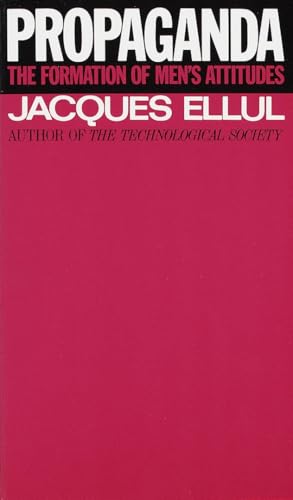
We saved the hardest for last, and the most important.
Jacques Ellul was a French sociologist who fought in the Resistance during WWII and spent his career at the University of Bordeaux studying the relationship between technology, propaganda, and modern society. His conclusion will ruin your comfortable assumptions:
Propaganda is not a tool used by governments. It is an environmental condition of technological society. And the people most susceptible to it are not the uneducated. They are the educated, information-seeking, media-literate citizens who believe they are immune.
Read that again. Ellul argues that education, media literacy campaigns, fact-checking initiatives, and “critical thinking” curricula don’t protect against propaganda. They accelerate its effects by creating people who consume more information, form opinions faster, and feel more confident in conclusions that were manufactured for them.
“It is a fact that excessive data do not enlighten the reader or the listener; they drown him. He cannot remember them all, or coordinate them, or understand them. If he does not wish to riskemic, he will simply not respond to the demands of propaganda. The only possibility is to refuse information, to deny its validity, or to construct for oneself a personal framework capable of withstanding the flood. But the latter demands a prior formation that few possess.”
“Propaganda ceases where simple dialogue begins. When two people genuinely engage in dialogue, exchanging views and questioning assumptions together, propaganda has no purchase. But modern media are structurally incapable of dialogue. They are instruments of monologue broadcast at scale.”
His taxonomy is architecturally precise: sociological vs political propaganda, integration vs agitation, horizontal vs vertical forms. Where Chomsky gives you a structural model of media, Ellul gives you a phenomenological model of propaganda as a total environment. You can’t escape it by turning off the TV. It’s in the architecture of the society itself.
The devastating insight
The person who reads 10 news sources and feels “well-informed” may be more propagandized than the person who reads none, because the informed person has internalized the frame without recognizing it as a frame.
After Ellul, you will never look at media literacy campaigns, fact-checking organizations, or “critical thinking” curricula the same way again. That makes this the hardest book on the list, not because of the reading level, but because of what it does to your certainty.
Where to Go from Here
This list is a staircase, not a menu. Each book builds on the foundation laid by the ones before it. If you read them in order, by the time you reach Ellul, you’ll have the psychological framework (Cialdini), the practical mechanics (Holiday, Bernays), the institutional critique (Chomsky, Postman), the neuroscience (Carr), and the structural model (Herman & Chomsky) needed to absorb the most demanding and rewarding text in the propaganda studies canon.
Browse the full collection with detailed reviews, format options, and related reading:
→ Propaganda & Media Studies: Full Guide Collection