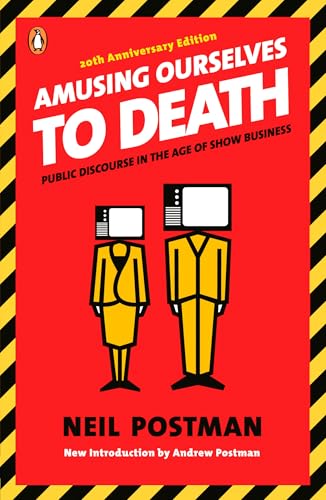
Amusing Ourselves to Death: Public Discourse in the Age of Show Business
Postman's 1985 argument that television had transformed public discourse from rational argument to entertainment spectacle. Contrasts Orwell's surveillance dystopia with Huxley's soma-fueled compliance — and argues we got Huxley's version. Remarkably prescient on social media, reality television, and the collapse of serious political conversation long before any of it existed.
Key Takeaways
- Orwell vs Huxley thesis — we got Huxley's compliance dystopia, not Orwell's surveillance state
- Television transformed public discourse from argument to entertainment
- Remarkably prescient on social media and reality TV decades before they existed
- Critical bridge between print-era media theory and the digital present
- Positions the medium itself as the propaganda mechanism
Written in 1985, Postman predicted the social media age with eerie accuracy. His core insight — that we wouldn't be oppressed by what we fear but by what we enjoy — is the essential complement to Orwell and the essential context for understanding why propaganda works even when people know they're being manipulated.
Neil Postman (1931–2003) was a professor of communication arts and sciences at New York University, where he founded the media ecology program. His work on how communication technologies shape culture and thought influenced fields from education to journalism to political science.
Media ecology and cognitive effects:
Related Books
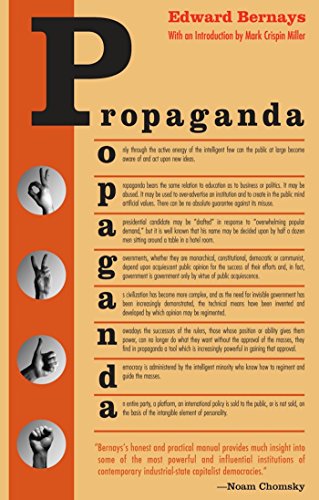
Propaganda (Bernays)
The founding document of modern public relations, written by Sigmund Freud's nephew. Bernays openly describes 'engineering of consent' as a necessary tool of democratic governance — mass manipulation framed as civic service. Short, direct, and eerily frank about the invisible government of public opinion shapers. Noam Chomsky called it 'an honest and practical manual.'

Media Control
A compact Chomsky pamphlet (~100 pages) and the ideal entry point into his political work. Traces American propaganda from Wilson's Creel Commission through the Iraq War, laying out his core thesis: 'Propaganda is to democracy what the bludgeon is to a totalitarian state.' Introduces the 'bewildered herd' concept and spectator democracy theory without the academic density of his major works.

The Shallows
Pulitzer Prize finalist examining how internet architecture — hyperlinks, notifications, infinite scroll — rewires neural pathways for distraction, making sustained critical reading harder. Where Postman analyzed the television medium, Carr applies neuroscience to the digital medium. The cognitive argument for why propaganda succeeds better in an internet-saturated population.
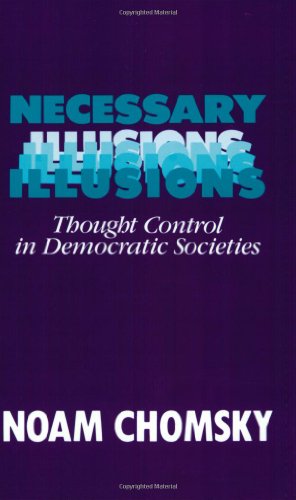
Necessary Illusions
Based on Chomsky's 1988 CBC Massey Lectures, this is the more analytically rigorous companion to Media Control. Examines how democratic societies maintain ideological control without physical coercion, using copious primary source documentation. The first 130 pages are lecture-derived and readable; the 220-page appendix is dense academic verification of every claim. Considered his most exhaustively sourced work.

Understanding Power
The most commonly recommended Chomsky starting point for readers who want breadth over depth — but earns its difficulty rating because of its length (416 pages) and subject range. Compiled from discussion transcripts, it covers US foreign policy, media analysis, social change theory, and domestic politics in digestible conversational segments. Footnotes are extensively cited and fact-checkable. Designed to be read non-linearly.

Manufacturing Consent
The landmark work in critical media studies. Herman and Chomsky's Propaganda Model identifies five structural filters — ownership, advertising, sourcing, flak, and anti-communism/fear — that systematically bias US media output toward elite interests without editorial conspiracy. Proven through detailed case studies comparing 'worthy' vs 'unworthy' victims in US foreign policy coverage. The most cited work in social sciences on media structure.
Intelligence Briefings
field-guide
The Propaganda Studies Reading List: 10 Books Ranked from Accessible to Academic
Invalid Date
Intelligence Briefing
Blind the Watchers: Inside Britain's Counter-Surveillance Uprising
Invalid Date
Intelligence Briefing
DO NOT READ THIS ARTICLE: An Archive of Britain's Cheekiest Counter-Surveillance Meme
Invalid Date
surveillance-intelligence
The Flock Safety Dossier: How a Startup Built America's Invisible Surveillance Empire
Invalid Date
Our Mission
InvisibleWare builds and curates counter-surveillance technology for activists, journalists, and anyone who refuses to accept mass monitoring as the cost of participation. We stock adversarial AI-disruption clothing, IR-blocking gear, Faraday equipment, and the essential books that explain why this work matters.
Your privacy is not a preference — it is a prerequisite for political freedom. Your data stays yours.